Sunday, July 21, 2019

Lyle Lovett and His Large Band, Definitively In Charge


Attending a Lyle Lovett and His Large Band concert is akin to living out the cliché "variety is the spice of life." Before the concert at Hoyt Sherman Place last week, my exposure to Lyle Lovett’s music was limited to “If I Had a Boat,” which I discovered through the gone-too-soon series Parenthood. For me, the variety was entirely unexpected: a country hoedown, a smoky jazz club, a Texas church service. Luckily, I was ready for anything and everything. And everything is exactly what I got.

The variety in Lovett’s music mirrors his varied career. Active in the music industry since the 1980’s, first as a songwriter then performing both solo and with the band, Lovett also dabbles in acting. I remember his brief marriage to Julia Roberts in the 90’s since, as a ten year-old Iowan, I always had my finger on the pulse of Hollywood. 

The concert kicked off with a rousing number from the band and then Lovett hit the stage and dove into "Pants is Overrated." I instantly agreed with the notion of the song in the most literal sense. Why wear pants when you could just leave those bottoms off? That was it for me. I was sold. The rollicking continued with "San Antonio Girl," the lyrics of which paint a picture of new love, a young man head over heels. "San Antonio Girl" is a prime example of one of Lovett’s greatest strengths: telling stories through song. Each song a novella, each verse a chapter.   

While I was right at home during the hoedown, I was a bit more leery to take a side trip to the jazz club. Riffs abound and all the members of the band get a chance to shine. There is no denying their musicianship, so while jazz is not my genre of choice I cannot help but appreciate the talent. Longtime Lovett performer Francine Reed can scat with the best of them. 

Lovett continued the set with what I now know to be his biggest hits, “If I Had a Boat” among them. I love the lyric at the end of the song, ‘kiss my ass I bought a boat/I’m going out to sea.’ What a great illustration of growing up and finding your place. “Here I Am,” “North Dakota” and his cover of “I’ll Fly Away” were also highlights. The rambling “Here I Am” is an interesting deconstruction of song, breaking the music with spoken word, and with a comedic lilt at that.

Eventually, the evening morphed into a life affirming church service. The hauntingly beautiful “Ain’t No More Cane” closed out the evening, the harmonies filling the hall and our souls. Of course, the audience would not let that be the end and Lovett and the band complied by coming back out for “Church.” 

Lovett’s stage presence is authentic. His rambling seems to acknowledge that he knows he must address the audience but that, in reality, he would be more comfortable simply performing. The audience on this evening – possibly typical for a Lovett and Large Band show – was much different than I anticipated. Hollering at Lovett on the stage, constantly leaving  - either to get more booze or, more likely given their age, to go to the bathroom. Not ideal, I favor an attentive audience who is there for the music rather than the chance to drink (or pee) somewhere other than their own home. 

Audience behavior aside, I am now a Lovett devotee. It's true that I am a sucker for a live concert experience, but they aren't all good. Not all concerts convince you to listen to the music after the show, go on a YouTube spiral, talk to others about the show, imploring them to listen to your favorites so you can talk about them together. Lyle Lovett and His Large Band sold me in the first two songs. 


Sunday, June 30, 2019

So Wrong It's Right


The show must go on, even when the whole universe is against it. The actors in the play within The Play That Goes Wrong know no other way. The Olivier Award-winning play breathes fresh air into the notion of the Broadway play. There is a place for high drama, but if the key to a happy life is balance then thank goodness for Henry Lewis, Jonathan Sayer and Henry Shields who have given us this comic gem. Few and far between are the shows that have the audience laughing from curtain up to curtain down. The plot is ridiculous, the set literally falls apart and the actors get just as many lines wrong as they do right, but that is all part of the plan. A flawlessly executed and acted plan. And how refreshing it is.

The Play That Goes Wrong is the story of a troupe of actors putting on the play "The Murder at Haversham Manor." The struggling troupe is thrilled to finally have discovered a show for which the number of characters matches the number of performers and their expectations are higher because of it – much higher than for their production of “Cat.” Unfortunately, there are a few things standing in their way and their skills may not match their ambition. 

Hilarity breaks out before the show within the show even begins. Before the show, stage manager Annie calls upon an unsuspecting audience member to physically hold up the mantel that will not adhere to the set wall. And it continues from there. One of the most enjoyable running jokes is that the actor playing the dead Charles Haversham cannot play dead. When, after the other actors step on his “dead” hand lying on the ground, he tries to sneakily move it under the chaise to avoid any further pain, the uproar from the audience was one of the most genuine moments of enjoyment I’ve heard in a theater in many years. The hijinks continue. A personal favorite: a sword breaks (of course) but the actor continues as if it is intact, shouting, “ching, ching” and “swish, swipe” in place of the actual sound of swords clinking together. Throughout the entire evening, the laughter rarely diminished. 

The cast is small but mighty. Anything less than complete commitment to the insanity would come across as disingenuous, but the tour cast is all in. Bear with me as I navigate the tricky waters of writing about actors who are portraying actors. Ned Noyes plays Max Bennett who portrays Cecil/gardener. Noyes hams it up as Max/Cecil, but in the best possible way. He grins, he bows during scenes and he eats up every reaction from the audience and uses it as fuel for his antics. Max is in love with himself on stage and Noyes plays it to perfection. Dennis (Scott Cote) plays the role of Perkins the Haversham Manor butler. Dennis does not have the best handle on pronunciation, or, really, his lines in general. His mispronunciation of ‘cyanide’ (ky-a-need-e) is so incorrect that, on the night of my performance, the audience reaction was delayed until another character corrected him. Once understood, the audience burst into laughter.  

Perhaps the most extraordinary element of “wrongness” in the show is the set.  Nigel Hook, the set original set designer, had quite a task to complete: design a set that will convincingly and precisely fall apart. The pre-show mantel shenanigans were only the beginning. Throughout the show, the set continues to fall apart, leading up to the moment at the end of the show when the walls fall down and the elevated platform that serves as a study loses its’ support beam and crashes to the stage floor. The gradual destruction is incredibly impressive. The planning and engineering required to create a set that falls apart and can be restored to its’ original form immediately after curtain call is hidden by the collapsing, crashing, falling and banging, but appreciation should be heaped upon the creative team and the backstage crew.

I could continue to gush for as long as Cecil could prance and bounce around the stage. That is to say, endlessly. Suffice it to say that The Play That Goes Wrong gets pretty much everything right. I know, I know, too easy. But Cecil would love that line. 

Sunday, June 23, 2019

The Kitch Lit Series: From Wizards to Ducks


After a Hogwarts-length break from the Kitch Lit genre, I was more than ready to get back in the kitchen. Harry Potter and his hijinks are to be applauded. JK Rowling tapped into something that is in many ways a classic tale, felt like something we had never read before. But there is no witchcraft in the kitchen, just good, old fashioned hard work. So while I readily jumped back into the kitchen, I wasn’t ready for was the emotional roller coaster that is Lillian Li’s Number One Chinese Restaurant. Li's novel centers around the Han family’s Beijing Duck House restaurant. In this tale, the restaurant is the sun around which the Duck House owners, employees and investors find themselves orbiting, some willingly, others, not as much. And that orbit is maintained by a gravitational pull so strong that it is nearly impossible to break the bond.

And this is where it gets tricky. To reveal too much about the plot is to take away the enjoyment of letting the story unfold before you. Life in and around a restaurant is all consuming. While life is different for front of house employees such as Nan and Ah-Jack, whose years at the Duck House have given them an uncommon bond, and manager Jimmy, who dreams of walking out from under the shadow of his father, they share one commonality: the consuming nature of the industry affects them whether they realize it or not.

Li shifts perspective seamlessly, writing in one chapter in the voice of a teenager and in another as the matriarch of the Han family who, since her husband’s death, is a shell of her former self. What we learn about each character expands in surprising ways when we step into their psyche. 

Number One Chinese Restaurant surprised me in all the best ways. Li’s prose is unbelievably smart and the story is as consuming as the restaurant industry itself. Who is really in charge of the Duck House? What motivates each character? Why do they act as they do? All will be revealed by the end, but Li leaves us wondering if there are even more sides to the story and, if it were to continue, what would happen with the characters we've come to know. A desire to read more is indicative of a well-crafted story. Li has accomplished just that. 

Monday, May 27, 2019

Safety in Sandwich


Stupid Judy.
It’s not often that I find occasion to quote Bruce Willis. Let alone Bruce in his non-action turn as the emotionally stunted image consultant who comes face to face with his childhood self in Disney’s The Kid. That was a lie. It is much more likely that I would quote non-action Bruce before action Bruce. Don’t tell Jake Peralta but I have never seen Die Hard. That said, I’ve ingested so much pop culture that movie, TV and even theme park quotes tumble from my mouth with regularity. My favorites:

“Stupid Judy” – Used to denote a person, place or thing that causes annoyance, from the pre-attraction film at EPCOT’s now defunct Universe of Energy attraction. Ellen DeGeneres, as a version of herself, is disgusted with her college roommate, Judy, played by Jamie Lee Curtis because Judy is wiping the floor with her on dream Jeopardy. Trust me, it all makes sense in context. Context that is now unattainable given the closure of the attraction. I’m sure there is something out there on the YouTube machine.

“Festivus Miracle” – To be exclaimed when joyfulness fills the air! It is rather remarkable the number of Seinfeld phrases that made their way into the pop culture lexicon. It is unlikely that any one show will ever again capture the zeitgeist so perfectly. Seinfeld is referenced in my daily life but Festivus Miracle gets used most often. Hit all the North/South lights green on the way through downtown? Festivus Miracle.

“Have a good trip, bring me back something French” – Can mean everything from goodbye, see you later or talk to you later to, actually, have a good time in France. What’s not to love about Home Alone? A classic good v. evil story: child takes on Wetbandits. Give it a whirl.

“Well, but she can’t work” – Usually meant to denote a situation in which I/you/we are not interested. Must be spoken with the pale, English sensibility of Matt Lucas. Bridesmaids stands out as one of the few movie experiences in which I truly laughed out loud, repeatedly, uncontrollably. An honorable mention to all of the lines from the airplane scene - because it’s civil rights.

"You’re covered in nuts" – Fits any and all situations. In The Heat, Paul Feig paired Melissa McCarthy and Sandra Bullock to immense comedic success. Some of the scenes go on a little long or are completely unnecessary (did Sandra really need to perform a tracheotomy in a diner? Probably not), but there are plethora of amazing lines in this one. Just watch:


Sunday, May 12, 2019

Where Will You Stand


The plan for this week’s post was derailed. My intent was to write about the musical adaptation of the movie School of Rock, but then I went to see The Steel Wheels in concert at CSPS Hall. And it became crystal clear. Why write about a mediocre musical when I could implore all seven people that read this to listen to The Steel Wheels? 

Before last week, my most recent Steel Wheels experience was at the Walnut Valley Festival last September. I was devastated to learn I was out of town later in the fall when they stopped in Ames. Of late, some of my family members are struggling to find good health inside bodies that have walked the earth for ninety-five years. Though my health remains intact, watching aging before your eyes is draining in more ways than one. A Steel Wheels concert is exactly what my soul needed. Not all musicians or bands are as good live as they are recorded. Fewer still are better. The Steel Wheels are in this select group. Their live performances pulsate with an energy that cannot be captured on a recording. One cannot help but be swept up.

The Steel Wheels give the impression that they never have an off night. This night was no exception. Trent Wagler, Jay Lapp, Brian Dickel and Kevin Garcia are uncommonly talented musicians and singers. In fact, even if they fumbled, the audience would never know and they would still be playing better than most musicians. Filling in for Eric Brubaker is Oliver Craven. Craven fits in perfectly; to the uninitiated he would never seem a substitute. One of the most touching moments of the evening came when the group dedicated “The Race” to absent member Eric Brubaker, who is taking time off to mourn the loss of his daughter. The sense of hopefulness and healing in the room was palpable.

The evening was a pretty typical Steel Wheels set: a mix of positivity and lamentation. Fast, driving songs alternate with slower more deliberate melodies. The Steel Wheels played a few songs from their upcoming summer release. “Under” drew me in. I can’t wait to listen to it again. The new songs they performed are distinctly Steel Wheels, but with a looser, relaxed quality that belies how hard they are working.

My favorite moment of the evening was the performance of “With It All Stripped Away.” Performed early in the set, this was the moment when The Steel Wheels grabbed hold of the audience and did not let go. Sung a cappella, the song is a call for reflection and action:

With no status, no power, no women, no men
With it all stripped away, where will you stand

With no profit, no weapons, no money in your hand
With it all stripped away, where will you stand

Stand up, in the early morning
(stand up) Stand up when there is no warning
(stand up) Stand up when the storm is rising, all around

With no color, no creed, no bible to defend
With it all stripped away, where will you stand

When this world (this whole world) turns violent, when there's no side left to win
With it all stripped away, where will you stand

Stand up when the wind is blowing
(stand up) Stand up when the tears are flowing
(stand up) Stand up when justice calls and you hear the sound

So when your quiet, alone, and this day has met its end
With it all stripped away, where will you stand


My opinion is abundantly clear. The more Steel Wheels in my life the better. Make your life better, too. Click Play. Oh, and School of Rock? You can skip it.


Monday, April 29, 2019

With A Smile On Your Face


Few artists have had as tremendous an impact on American music as Carole King. Since the jukebox bio musical was welcomed on Broadway more than a decade ago, it was only a matter of time before enterprising producers ventured to bring her life and music to the stage. Upon seeing Beautiful on tour a couple of years ago, I immediately decided that I needed to see it again. It was different than I had expected and I needed to see it again through different eyes. And so it was that I found myself on a Sunday evening in New York City, in search of a show. After stage dooring the final performance of Kinky Boots for well over an hour, I practically sprinted from the Hirschfeld to the Sondheim to get to my seat before curtain. Beautiful is well-written and expertly designed and it pays, pun intended, beautiful tribute to Carole King and her contribution to American music.

Beautiful spans the early years in King’s career – which began with a hit song at 17 years old – and concludes with the release of her monumentally successful album Tapestry. Married as a teenager to chemist and aspiring lyricist Gerry Goffin, King and Goffin pumped out hit songs as frequently as the rest of us pour a bowl of cereal (by which I mean a lot, I eat a ton of cereal). Goffin, brooding and discontent, bristled at the prospect of settling into family life, while King dreamed of a sort of suburban utopia. The love they shared was not enough to sustain their marriage. During the early phases of Beautiful’s development, King admitted to having little interest in seeing a musical adaptation of her life and, watching her story unfold on stage, it is not hard to imagine that were we in her shoes we would feel similarly hesitant. A perfect hand King was not dealt. But from what I have gleaned about the actual King from watching many concerts and PBS specials (and speaking to her oh so briefly at a Get Out the Vote rally many moons ago) she has an enviable resilience, her dry humor a defense mechanism that, rather than close her off from experience and emotion, sustains her positivity. Book writer Douglas McGrath captures King’s innate sense of joy. Indeed, it's not hard to imagine King uttering some of his quick-witted dialogue. 

If McGrath gives words to Carole King the character, it is up to the star to bring her to life. As Carole King, Chilina Kennedy, who has played the role extensively, has an assuredness that is in a class of its own. She imbues King with an inner strength that lies close to the surface, springing forward in the face of adversity. Importantly, Kennedy does a nice job of incorporating some of King's speech and singing patterns without simply seeming to mimic her. Evan Todd as Gerry Goffin, and Kara Lindsay and Ben Jacoby as fellow songwriters, friends and competitors Cynthia Weil and Barry Mann round out the leading cast. The talented ensemble of singers and dancers keep the show moving, playing multiple roles and inhabiting such famous singers as Neil Sedaka, The Drifters and The Shirelles.

The costumes, choreography and design of the show are superbly polished.  Synchronized doo-wop dancing is irresistible and Beautiful has smooth moves to spare. Crisp, shiny suits catch the spotlight with every bend of the knee and flick of the wrist. The set is understated but not boring. Take, for example, the multi-level 1650 Broadway set, a Brill Building type complex in the songwriting "block" of Manhattan. With its’ spare feel and visible steel, the set reinforces the sort of industrialized production of hits that came to be known as the Brill Building sound.

The high quality of the music featured in Beautiful is, of course, a forgone conclusion. King truly wrote the music of a generation. The music credits in the Playbill read like a comprehensive history of the American song. Beautiful showcases upbeat hits such as “The Locomotion” and “He’s Sure the Boy I Love” and nimbly transitions to heavier emotion with “Will You Love Me Tomorrow” and “One Fine Day.” The latter of which can be a fun, bouncy hit outside of the context of the scene. But here, when Gerry admits to having a relationship with singer Janelle Woods (who is on stage singing the song for a TV broadcast) and Carole takes over the song from Janelle, the song takes on a bittersweet note. The tone is perfect in that moment, the close of Act I. Note that as a Positive Patty I subscribe to the out of context version of the song when my alarm goes off at 7:00 in the morning.

I find myself at a loss for words to sum up the show. Maybe it's because Beautiful is just that. Beautiful. The conclusion of the show is perfect, ending with King's 1971 concert at Carnegie Hall and King, alone at the piano, belting the titular song. With humor, heart and a brilliant set of tunes, Beautiful will remind you of your youth or, if you're like me, make you wish you were growing up at a time when spunky girl from New York City was changing the music industry and paving the way for a generation of singers and songwriters.


Sunday, April 14, 2019

A Tale of Two Dresses


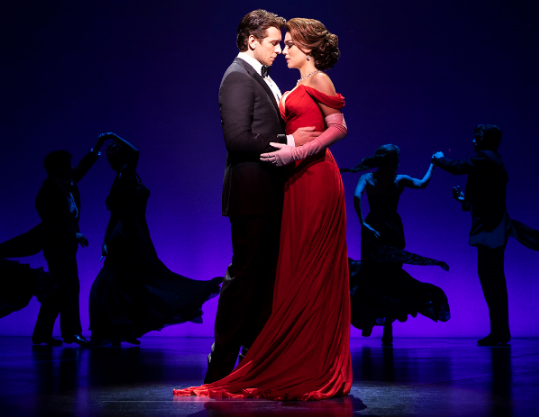
Musical adaptations of hit films are downright ubiquitous on Broadway. What Hairspray kicked off nearly two decades ago (mother of pearl, typing that sentence makes me feel old) has continued with varied degrees of success. As with many things in life, quality and success do not necessarily go hand in hand. The Lion King continues it’s multi-decade run just a few streets over from Aladdin. For every Kinky Boots there is a Ghost: The Musical. I will leave it up to you to determine into which bucket each of these shows fall. A visit to New York City last week gave me the opportunity to see two members of the newer crop of movie adaptations: Pretty Woman: The Musical and Tootsie. Pretty Woman feels worn and sluggish while Tootsie brims with a fresh energy. Indeed, the only thing these two shows share is the fact that, at some point in the show, the main character is outfitted in a bright red dress.

The movie Pretty Woman was huge when it was released in 1990, and is probably best known for solidifying Julia Roberts as one of the biggest and most bankable Hollywood stars. With music by Bryan Adams and Jim Vallance and a book by Gary Marshall and J.F. Lawton, also the film’s screenwriters, the musical is a retread. The story, setting and time period are nearly cookie cutter copies of the movie and it suffers because of that. The chance to simply add music is not enough to warrant a transfer to the stage. Adapting a movie for the stage brings with it the opportunity to make changes and tailor the story for a new medium and, often, a new decade, but Pretty Woman does not take full advantage of that opportunity.

Samantha Barks and Andy Karl, in the undoubtedly difficult position of filling the shoes of Roberts and Richard Gere, do everything they can with the material. Barks and Karl are undeniably talented, as is the hard-working ensemble and supporting cast. But the story and music does not resonate. Watchable? Sure. Completely needed? Probably not.

By contrast, across town, the adaption of the 1982 Sydney Pollack film Tootsie hits all the right notes. Now set in the present day, and with the show-within-a-show flipped from a soap opera to a Broadway musical (meta opportunities abound), Tootsie makes the argument for its’ creation that Pretty Woman does not. The creative team of Robert Horn, David Yazbek, Denis Jones and Scott Ellis have crafted the quintessential musical comedy: song and dance, conflict and resolution, sarcasm and sentiment.

A man masquerading as a woman in order to get a job is tricky water to navigate in the #MeToo era and, while some of the topical references are a bit heavy-handed, the show successfully navigates relationships in many different forms: male friendship, female friendship, female/male friendship, romantic relationships and, perhaps most importantly, the relationship with oneself. The cast, led by future Tony Award winner Santino Fontana is exceptional. No really, I’m no expert, but Fontana’s hilarious and heartfelt performance as Michael Dorsey/Dorothy Michaels is brilliant. Dustin who? He commands your attention and earns your respect. The supporting cast features strong turns from Lilli Cooper as Julie, Andy Grotelueschen as Jeff and Sarah Stiles as Sandy. Stiles, as Michael’s codependent ex-girlfriend with a few hilarious peculiarities about her, is the definition of a scene stealer. I challenge you not to laugh when Sandy laments her attempt at doing the Dirty Dancing lift with her cat.

Still in previews, Tootsie cannot yet be judged as a final product, but, if the preview performance I saw is any indication, Tootsie has legs – and not just Santino Fontana’s gams in that iconic red dress. Tootsie has the energy and the compassion to strut down 46th Street and into our hearts. So, I beg you Broadway audiences, please reward Tootsie’s quality with financial success so that it plays long enough for me to get back to see the finished product. Please.